---
title: Bank transfer reversal
description: Resolve a Frec account deficit via portfolio line of credit, ACH, or wire transfer. See resolution timelines and learn how to protect your holdings.
---
[Skip to content](https://help.frec.com/en-us/bank-transfer-reversal#main-content)
[](https://help.frec.com/en-us?hsLang=en-us)
- [Contact help](https://help.frec.com/contact-help)
- [Login](https://frec.com/app/login)
Open main navigation
Close main navigation
- [Contact help](https://help.frec.com/contact-help)
- [Login](https://frec.com/app/login)
This is a search field with an auto-suggest feature attached.
- There are no suggestions because the search field is empty.
1. [Frec Help Center](https://help.frec.com/en-us?hsLang=en-us)
2. [Transfers & deposits](https://help.frec.com/en-us/transfers-deposits?hsLang=en-us)
3. [Cash transfers (ACH & Wire)](https://help.frec.com/en-us/transfers-deposits?hsLang=en-us#cash-transfers-ach-wire)
September 14, 2026
# Bank transfer reversal
### What happens if a deposit is reversed
There is a $30 fee for any bank deposit reversal. You can avoid this fee, and the issues below, by:
- Confirming you have sufficient funds in your external bank account, with no pending transactions that could reduce that balance, before making a deposit. This applies to recurring deposits too, since a scheduled deposit can still be reversed if your linked account doesn't have enough funds on the day it's processed.
- Confirming with your external bank that you're permitted to connect the specific account you're linking. Some banks restrict certain account types, so it's worth checking before you connect an account to Frec.
### What happens if a deposit is reversed
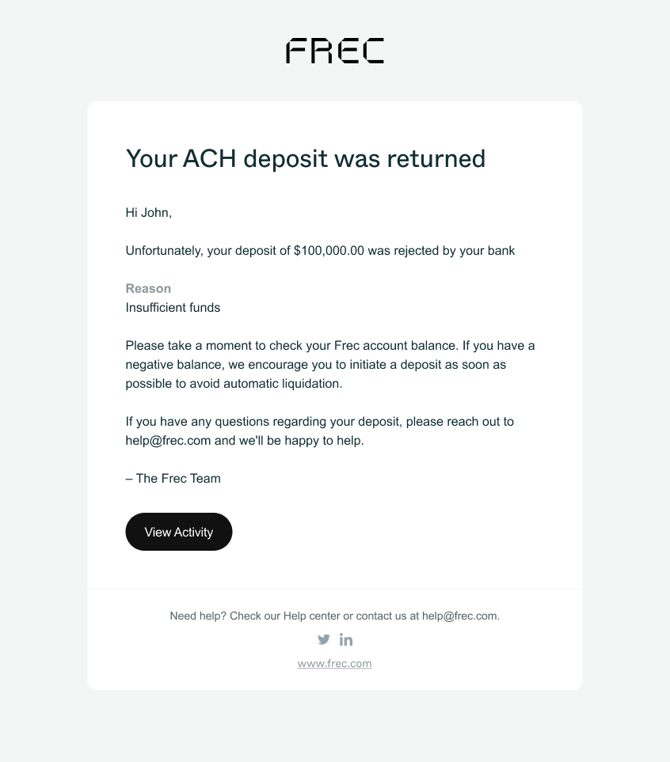
Because deposited funds may already be invested by the time a reversal happens, a reversed deposit typically creates a cash deficit in your account rather than simply returning the transfer. If this happens, we'll email you to explain the deficit and ask you to cover it.
### 
### Covering a deficit
You can cover a deficit by:
- Borrowing funds from your portfolio line of credit (PLOC) and directing them to the account with a deficit, or
- Sending a new ACH or wire transfer for the shortfall amount.
If you cover the deficit via ACH, please provide proof that sufficient funds are available.
### If the deficit isn't resolved promptly
Please respond to any deficit notice as soon as possible. If the deficit isn't resolved promptly, we may need to sell other holdings in your account to cover it, which could result in tax implications.
If you're covering the deficit via wire, you'll still need to submit it before the same-day wire cutoff. Wires cannot be processed on weekends or bank holidays.
Multiple reversal fees can also cause Frec to place a restriction on your account, or lead to account closure.
[](https://frec.com/)
FREC © 2026 Frec Markets, Inc. All rights reserved.